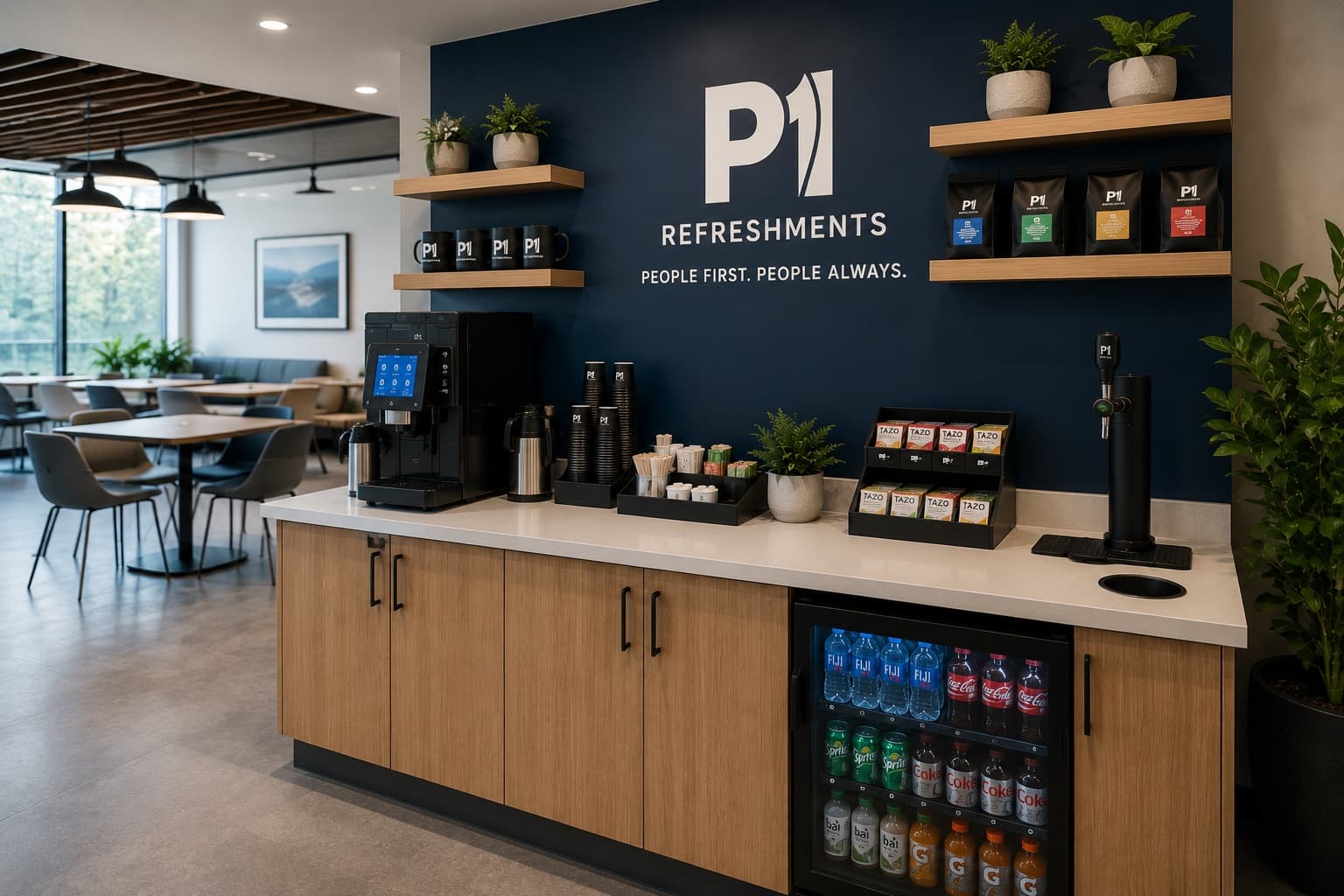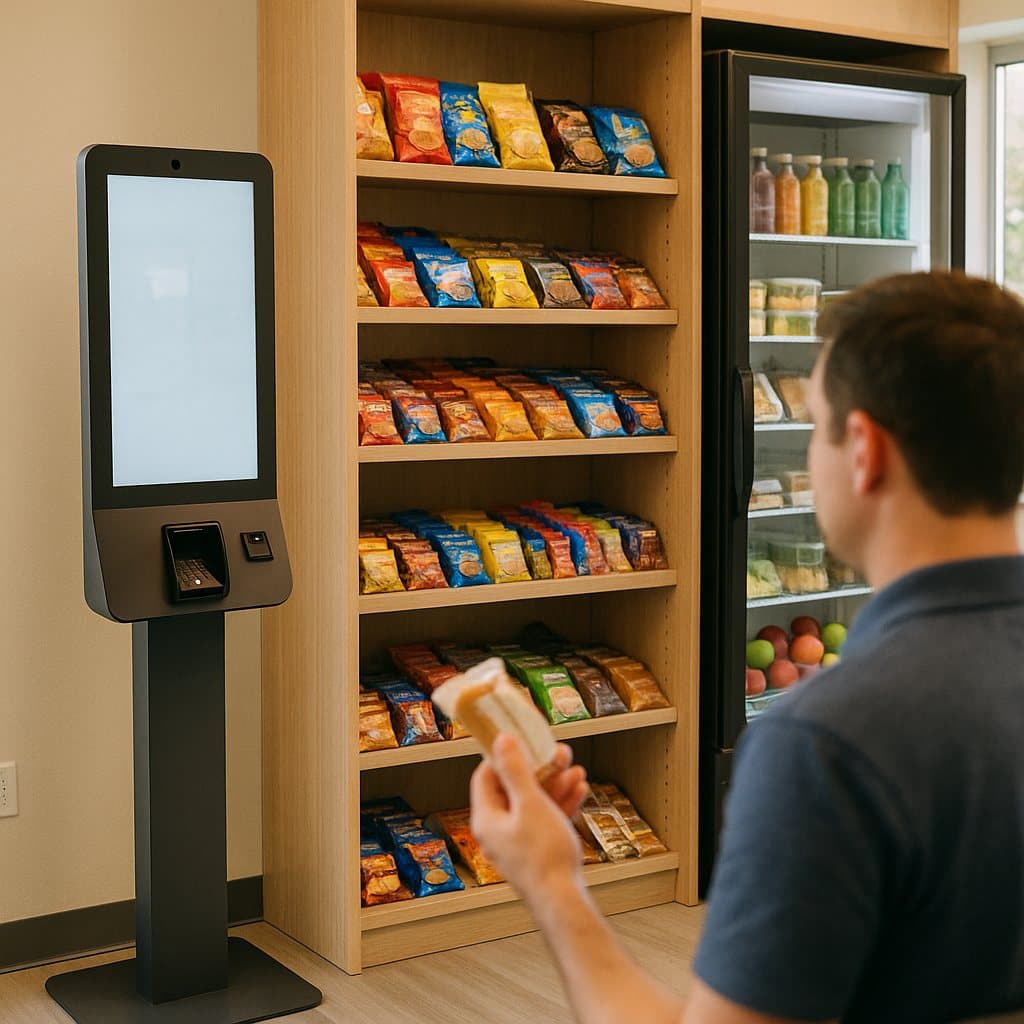
A micro-market is a small, self-service convenience store placed right inside your workplace. Employees browse open shelving and refrigerated displays, then check themselves out at a kiosk — no cashier, no leaving the building. It holds far more variety than a vending machine, including fresh food, typically fits in about 100 to 250 square feet, and suits larger teams that want choice.
If you have walked through an airport or a modern office lately, you may have seen one without knowing its name. Open shelves of snacks. A cooler of fresh sandwiches and drinks. A small kiosk where people scan what they grabbed and walk out. That is a micro-market — and for a growing number of Greater Waco workplaces, it is quietly replacing the row of vending machines in the corner.
This guide explains what a micro-market actually is, how it differs from vending, and how to tell whether your breakroom is ready for one — in plain language, with no sales pitch.
What is a micro-market, exactly?
A micro-market is a self-service convenience store located right inside your workplace.
Instead of buying through a machine, employees browse open shelving and refrigerated displays, pick up what they want, and check out at a self-service kiosk. The result is a wider selection, more fresh-food options, and a space that feels open and welcoming rather than mechanical.
It is everything people appreciate about a neighborhood market — without anyone having to leave the building.
Micro-market vs. vending: an honest comparison
Vending machines are an excellent fit for many Waco workplaces, and we are glad to install them. A micro-market is not "better" — it is a different tool for a different team. Here is how they actually compare.
| Vending Machine | Micro-Market | |
|---|---|---|
| How you buy | Select behind glass | Browse open shelves, self-checkout |
| Best for | Smaller teams, tight spaces | Larger teams who want variety |
| Product variety | About 40-60 items per machine | 150+ items, including fresh meals |
| Fresh food | Limited | Sandwiches, salads, parfaits, fruit |
| Space needed | About 15-20 sq ft | Roughly 100-250 sq ft |
| Payment | Cashless tap or card | Kiosk, mobile wallet, payroll deduction |
| Breakroom feel | Functional | Open and inviting |
If your team is small or your space is tight, vending is often the smarter place to start. As a workforce grows, a micro-market starts to earn its footprint with the variety and fresh-food choices a machine simply cannot hold.
Signs your Waco breakroom is ready for a micro-market
A micro-market is not about square footage alone. A few things tend to point toward it being a good fit:
- Your team has grown past what a couple of machines can comfortably serve.
- People are leaving the building for lunch because the breakroom does not offer enough.
- You want to offer fresh food, not just packaged snacks.
- The breakroom has become a place people pass through rather than a place they want to be.
None of these are hard rules. They are simply the patterns we see most often when an employer is ready to give their team something better. And if your people are spread across several buildings or a larger site, a micro-market for multiple buildings or a campus covers how the format scales when one breakroom cannot reach everyone.
Who handles all of it?
This is the question we hear most, and the answer is simple: we do.
We monitor inventory remotely. We restock on a schedule built around how your team actually uses the market. We maintain the equipment. And when a question comes up, you reach a local person who knows your account — not a distant call center.
Because the goal was never just to install shelves. It is to create a breakroom your employees genuinely enjoy using.
That is the difference between placing equipment and becoming a partner — and it is the same standard behind our managed micro-market service and micro-markets for Waco workplaces, one stocked shelf and one well-served break at a time.
If you are ready to go deeper, our piece on choosing between vending and a micro-market for a growing Waco facility walks through the decision, and how much space a micro-market actually needs covers the room, power, and layout side before you commit.
People First. People Always.