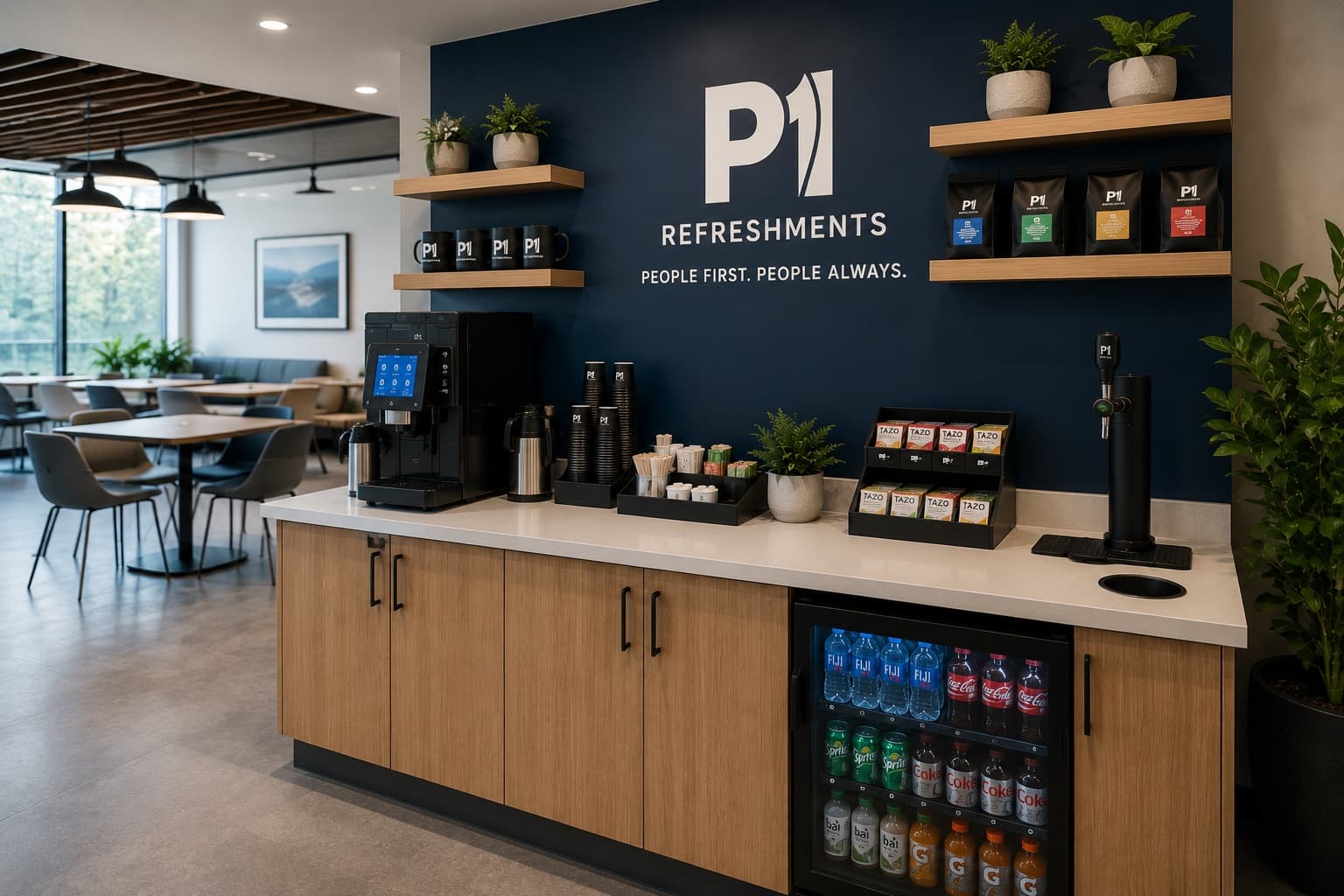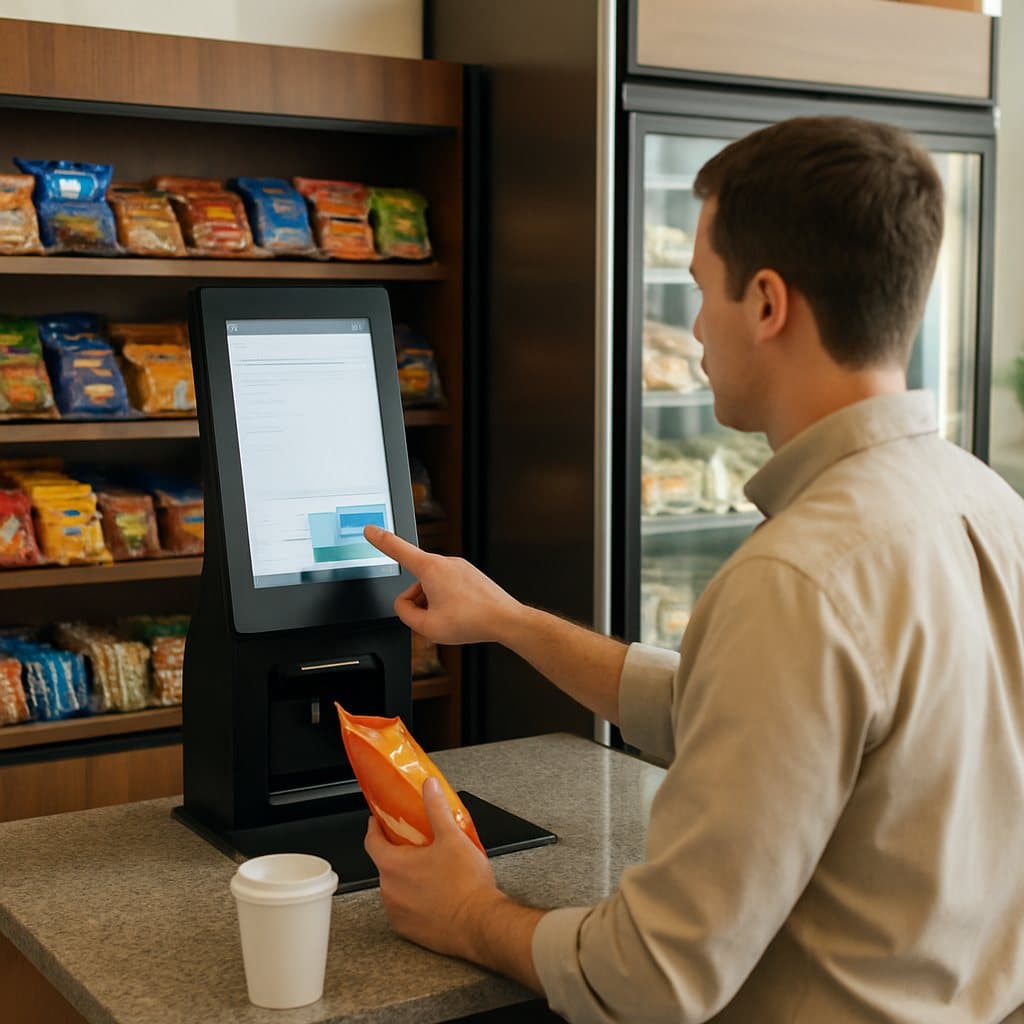
A micro-market is a strong fit for a multi-building employer or campus, because scattered teams concentrate enough daily traffic to support a full self-service store. Depending on layout, that means one central market where the most people pass, or a market per building with vending covering the smaller spots, all run through one provider. The key is matching format to traffic, building by building.
Employers with more than one building face a breakroom problem a single-site company never does: your people are spread out. A vending machine by the front desk does nothing for the team two buildings over, and asking everyone to walk across a campus for a snack is a non-starter.
A micro-market program is built to solve exactly that, when it is designed around how a multi-building site actually works. This post covers how to cover scattered teams without scattering the management across a half-dozen vendors.
Why a campus is a natural fit for a micro-market
A micro-market rewards traffic. The broad footprint, the coolers, the fresh food, all of it pays off when enough people use it day in and day out. That is precisely what a multi-building employer brings to the table.
A single small office may sit below the daily traffic a full market needs. A campus rarely does. Pool the people moving through several connected buildings and you clear the threshold a lone office cannot, which is why larger multi-building employers, the kind of multi-campus operations common around Greater Waco's healthcare systems, higher-education institutions, and large industrial sites, are among the best-suited workplaces for the model.
One central market or one per building?
There is no single right layout. The answer follows how people actually move across your site, and it usually lands on a mix.
| Coverage approach | When it fits | What it looks like |
|---|---|---|
| One central market | A campus where most people pass a common hub | A single full micro-market positioned where foot traffic concentrates |
| A market per building | Several buildings each with steady daily traffic | A full self-service store in each high-traffic location |
| Markets plus vending | Mixed traffic across buildings | Markets in the busy buildings, vending in the smaller or lower-traffic spots |
The honest test in every case is daily on-site traffic, not raw headcount. A building humming with people justifies a full market; a quieter satellite is often better served by a no-equipment-cost vending machine. We map each building to the format that fits it, so nothing is over-built or left under-served.
The thing that makes multi-location work: one point of contact
The real difficulty with a multi-building breakroom is not the equipment. It is the coordination. Run each building through a different vendor and you inherit a tangle of invoices, inconsistent selection, and nobody clearly accountable when one location runs dry.
A managed program solves that by routing the whole campus through one local provider. We handle stocking, servicing, inventory monitoring, and the product mix across every building, and you reach one accountable person rather than a queue per site. Self-checkout and cashless payment, including Apple Pay and Google Pay, behave identically at each location, so the experience is consistent wherever someone works.
That single relationship is the difference between a campus program that runs smoothly and one that quietly falls apart building by building.
What does a micro-market cost an employer with several buildings?
Under a managed model, you do not buy the fixtures, coolers, or kiosks for each location, the provider owns and services them, so you avoid the upfront capital outlay of self-building a store in every building and pay for a managed service instead. Employees pay per item at self-checkout. A self-built market, by contrast, carries a real capital cost per site, which is exactly why most multi-building employers choose the managed route. We scope coverage to your campus layout and traffic rather than a fixed per-building package, and our breakdown of what a micro-market costs an employer walks through the managed-versus-self-built math in detail.
Grounding it in the Waco you operate in
It helps to picture the kind of site this fits. Across Greater Waco, the major employers, led by healthcare systems, higher-education institutions, and sizable industrial operations, often run across multiple buildings or a full campus, and a workforce of roughly 66,000 in Waco alone gives those sites the steady daily traffic a market depends on. Where people would otherwise have to leave a campus to find a real lunch, an on-site market with fresh food saves a real chunk of the workday.
That is the lens behind our managed micro-market service and everything in our micro-markets for Waco workplaces: we look at how your people are spread across buildings, match each space to the right format, and run all of it on one accountable relationship. If you want the upgrade story from a single bank of machines, what a micro-market is, explained for an industrial site covers the leap.
Because a campus breakroom should not feel like five disconnected ones. It should feel like one workplace that thought about its people wherever they happen to sit, and that is the whole point.
People First. People Always.