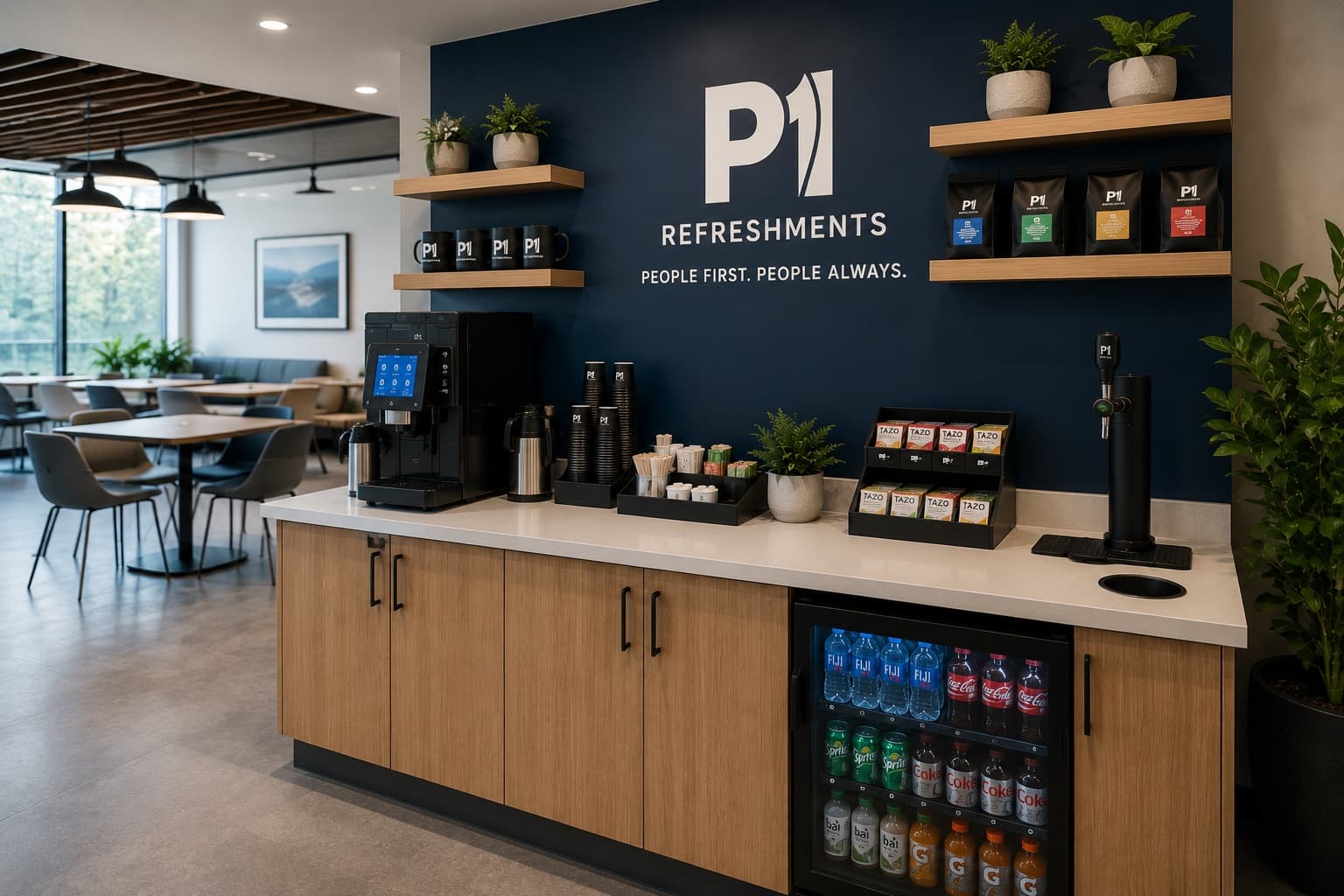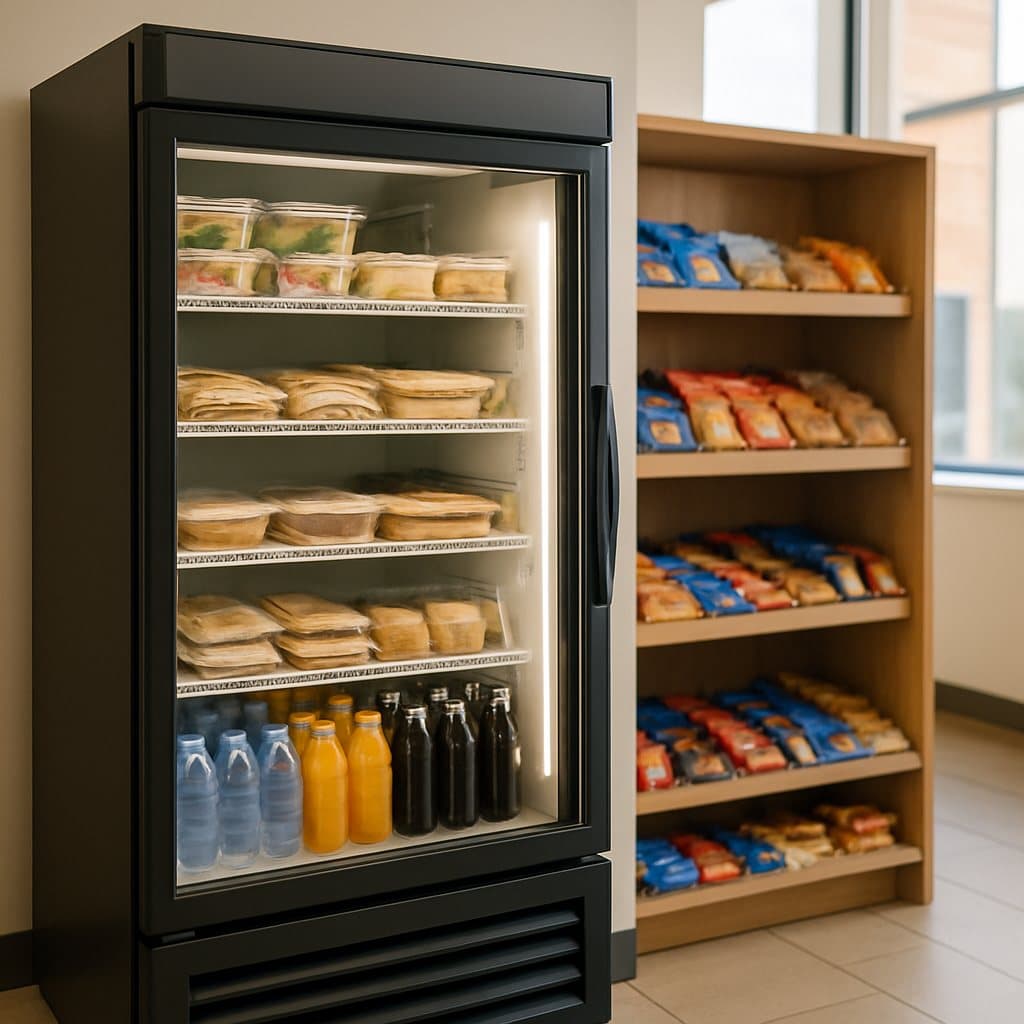
A micro-market is a small, self-service store set up inside the plant: open shelves and coolers hold snacks, drinks, fresh food, and full meals, and workers check themselves out at an unattended kiosk, 24/7, with a card or phone. Under a managed model the provider owns and services the fixtures and kiosk, so the plant skips the capital cost of building its own store, and a third-shift crew gets the same access as the day shift.
On a manufacturing floor, the breakroom is not a nicety. It is where a crew refuels in the middle of a long, physical shift, and the options there shape whether people leave the site for food or stay, rest, and get back to work. For a lot of plants, a row of vending machines is the default, and it leaves a real gap, especially at the hours when nothing else is open.
A micro-market closes that gap. Here is exactly what one is, how it works inside a plant, and why it tends to beat a vending bank for an industrial crew.
What is a micro-market on a plant floor?
Picture a small convenience store, set up right in the plant's break area, that runs itself.
Open shelving and refrigerated cases hold the selection out in the open, where workers can see it, pick it up, and read a label, rather than squinting at it behind glass. The range goes well beyond a machine: packaged snacks and drinks, yes, but also fresh food, sandwiches, salads, and full heat-and-eat meals. When someone is ready, they check out at an unattended self-checkout kiosk, paying with a card, a tap, or a mobile wallet. No cashier, no line, no fixed hours.
That last part matters more on a plant floor than almost anywhere. Because the kiosk is unattended and always on, the market does not close. A crew clocking in at 10 p.m. walks up to the same stocked store the morning shift used.
How a micro-market works for the plant, and who owns it
The setup is simple to use, and under a managed model it is simple to bring in too, because the heavy part sits with the provider.
We design it to your floor
We look at your headcount, your shift pattern, and your space, then lay out the shelves, coolers, and kiosk to fit the plant break area.The provider owns the equipment
Under a managed model, the provider supplies and installs the fixtures, coolers, and self-checkout kiosk and owns them, so the plant avoids the capital outlay of building its own store.We stock and service it
We plan the product mix, restock on a schedule, keep the fresh food rotated, and maintain the kiosk and coolers, so it never becomes a job for plant staff.Workers check themselves out
Employees browse the open shelves, grab what they want, and pay at the kiosk with a card or mobile wallet, any hour of the day or night.
The key thing for a plant manager weighing it: a managed micro-market is not a store you build, staff, and own. The provider owns and services the equipment, you supply the space and power, and employees pay per item at the kiosk. What the plant avoids is the capital cost and the labor of running a small store on the floor.
Micro-market vs vending bank on a plant floor
A lot of plants already have machines, so the real question is what a market adds. The honest answer comes down to variety, fresh food, and the experience.
| Vending bank | Micro-Market | |
|---|---|---|
| Selection | Curated and compact, behind glass | Broad and open, including fresh food and full meals |
| Fresh food | Limited to packaged items | Yes — sandwiches, salads, heat-and-eat meals |
| Experience | Pick a slot, buy one item | Browse an open store, see and handle the product |
| Hours | 24/7, cashless | 24/7, cashless self-checkout |
| Best for | Smaller crews or tight space | Larger or multi-shift crews working meal hours on-site |
| Who owns the equipment | Provider, under a managed program | Provider, under a managed model |
The pattern is clear. A vending bank is a fine fit for a smaller crew or a tight footprint. A micro-market earns its place when the crew is larger, the shifts run around the clock, and people are eating real meals on-site instead of leaving the property. The fresh-food range is usually what tips it, because a machine simply cannot put a sandwich or a salad in front of a worker the way an open market can.
Does it work for round-the-clock crews?
This is where a micro-market separates itself most for manufacturing, and it is worth being plain about why.
The hardest hours to feed a team are the ones a staffed option cannot cover. A cafeteria closes; an unattended micro-market does not. A 2 a.m. crew walks up to the same stocked store, the same fresh food, the same full selection the day shift had, with no overnight staff required to make it happen. For a multi-shift plant, that round-the-clock parity is often the entire case. It says the company thought about the third shift, not just the people who happen to work nine to five.
Is theft a problem with an unattended plant market?
It is a fair concern, and the honest answer is that shrink in self-checkout micro-markets is generally low and actively managed, not ignored. A closed payment base, cameras, and the plain reality that the market sits inside a workplace among coworkers keep honest losses small in published industry experience. We are upfront about the honest range and how the setup keeps it down, rather than pretending it is zero. For nearly every plant, the convenience, the morale lift, and the fresh-food access far outweigh the modest, well-controlled shrink. If you want the full picture, our look at whether micro-market theft is a problem covers it in detail.
Bringing it to a Greater Waco plant
Manufacturing runs deep across Greater Waco and McLennan County, from the plants in Waco itself to the fabrication and rail-equipment shops in McGregor and the industrial corridors out toward Bellmead and Lacy-Lakeview. Those are exactly the multi-shift, meal-hours-on-site operations a micro-market is built for.
If you want the broader, non-industrial primer first, what a micro-market is for Waco employers covers the general version, and how a micro-market works at self-checkout walks through the mechanics step by step.
Everything here runs through our managed micro-market service and our micro-markets for McGregor workplaces: we design it to your floor, own and service the equipment, and keep every shift fed without it becoming a job for your team.
Because on a plant floor, a real meal at 2 a.m. is not a perk. It is a signal that the people working the hardest hours matter just as much as everyone else, and that is the whole point.
People First. People Always.