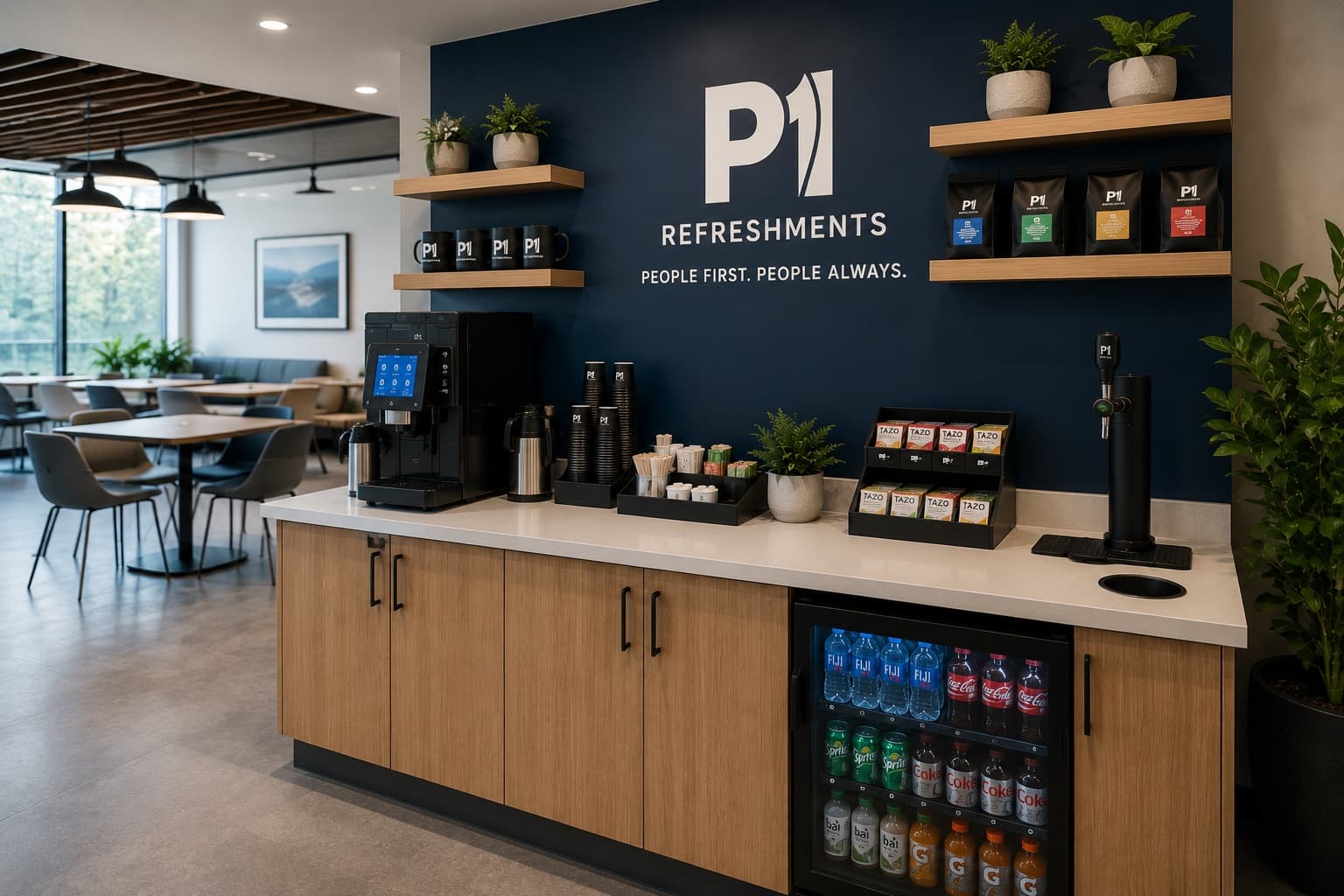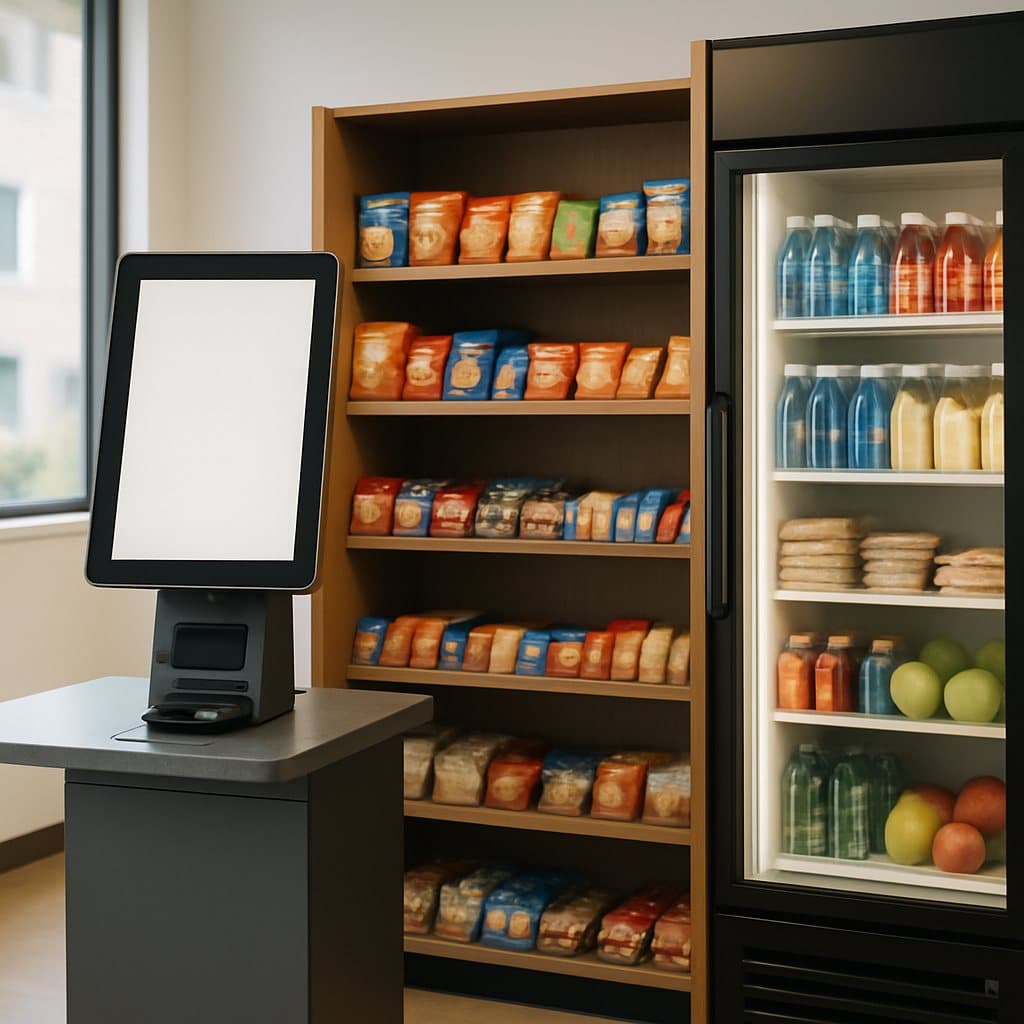
A micro-market is a small, self-service store inside your workplace: open shelves and coolers hold snacks, drinks, and fresh food, and employees pick what they want and check themselves out at a kiosk with a card, mobile wallet, or market account. No clerk, no machine to fight, no cash. Under a managed program we own the fixtures, stock it, and keep it running.
If you have ever walked into a breakroom, grabbed a salad and a cold brew off an open shelf, tapped a card at a small kiosk, and walked out, you have used a micro-market. For everyone who hasn't, the format can sound more complicated than it is. It is genuinely simple, which is most of the point.
This post explains exactly how a micro-market works, from the shelves to the self-checkout to how it stays stocked, so you know what you are actually getting before you put one in.
What is a micro-market, in plain terms?
A micro-market is an unattended, self-service store built into a workplace breakroom.
Instead of a closed machine with a coil and a window, you get open shelving, refrigerated and sometimes frozen cases, and a self-checkout kiosk. Employees browse like they would at a small market, pick up exactly what they want, including fresh food a vending machine could never hold, and check themselves out. There is no cashier and no one standing behind a counter. The whole thing runs on trust and good technology, and it works.
That open, store-like layout is the core difference from vending, and it is what unlocks the variety and fresh food people actually want on-site.
How does the self-checkout actually work?
This is the part people wonder about most, and it is the simplest part of all.
At the kiosk, an employee either scans each item's barcode or taps it on a touchscreen, then pays. Payment is fully cashless: a tap of a credit or debit card, a mobile wallet like Apple Pay or Google Pay, or a pre-loaded market account that some workplaces set up by badge or app. The transaction takes seconds, there is no line because everyone checks out independently, and the kiosk records what sold so the inventory data stays current.
How does payment work without a cashier?
Payment works because the kiosk is the checkout. Employees pay per item at the screen, the same per-item model as a vending machine, so the cost of the product itself stays off the employer. Most markets accept tap-to-pay cards and mobile wallets, and many add a market-account option employees can pre-load and pay from quickly. There is no cash drawer to manage and nothing for your staff to reconcile. We set up the payment methods that fit how your workplace prefers to pay, and the system handles the rest.
How does it stay stocked and honest?
Two fair questions follow naturally: who keeps it full, and what stops people from just walking off with things?
On stocking, a managed market is monitored and replenished on a schedule, so popular items are restocked before they run out instead of after the complaints start. On honesty, the open format is paired with a sensible closed-base layout and security cameras, and published industry figures generally put micro-market shrink in a low single-digit percentage range that the format is designed to keep manageable. In practice, workplace markets rely on the fact that a team checking out among coworkers tends to do the right thing, and the technology quietly backs that up.
We dig into that trust question in depth in our piece on whether micro-market theft is really a problem, because it is the concern employers raise most, and it has a genuinely reassuring answer.
Who sets it up and keeps it running?
The format only feels effortless because someone is doing the work in the background. Under a managed program, that someone is us.
Here is the whole arrangement, start to finish:
We assess your space and team
We look at your headcount, foot traffic, and the footprint you have, then design a market that fits — not a fixed package.We own and install the equipment
Under the managed model, we provide the shelving, coolers, and self-checkout kiosk, so you avoid the upfront capital outlay of building your own. You provide the space and a standard power supply.We stock it to your team
We plan the product mix, keep the shelves and coolers full on a monitored schedule, and rotate selection so favorites stay available and fresh food stays fresh.Employees check themselves out
Your team grabs what they want and pays per item at the kiosk with a card, mobile wallet, or market account. No clerk, no cash, no waiting.
Notice the split: the convenience is your team's, and the work is ours. You are not running a small store; you are giving your people a real on-site amenity that takes care of itself.
Is a micro-market right for your workplace?
The mechanics are simple, but fit still matters, and it comes down to space and daily traffic.
A market rewards workplaces with enough room for shelves and coolers and enough steady on-site users to keep it busy. If your team has outgrown a couple of vending machines and people want more variety and real fresh food, that is usually the signal. If the footprint is tight or the traffic is light, a vending program may still be the better call, and we will tell you honestly which fits.
For the side-by-side, our honest micro-market versus vending comparison lays out the trade-offs, and what a micro-market is for Waco employers covers the bigger picture. The practical space a micro-market needs is worth reading before you commit.
Either way, the setup runs through our managed micro-market service and micro-markets for Waco workplaces: you provide the space, we provide the rest, and the market stays stocked without becoming a job for your staff. If a market isn't the fit yet, our managed vending service is where most workplaces start.
Because a great breakroom should feel effortless to the people who use it. Making the work disappear is the whole point.
People First. People Always.