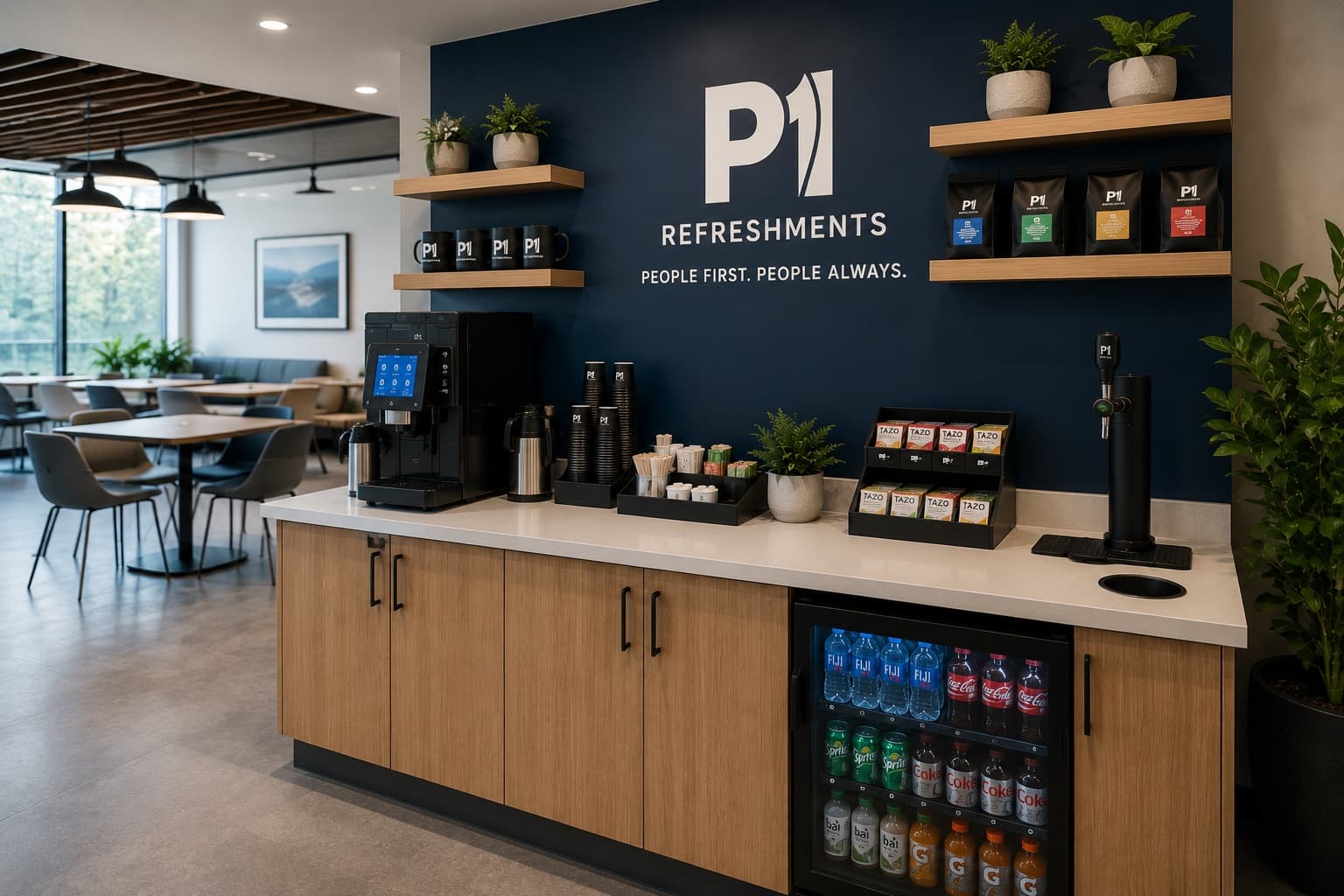
A workplace micro-market typically needs about 75 to 300 square feet — roughly 75 to 150 for a compact, snack-and-drink setup, and 200 to 300 once you add fresh food and a freezer. The real footprint follows your headcount, your variety, and how people move through the room.
It is the question we hear before almost any other: how much space does a micro-market need in a workplace breakroom? It is a fair thing to ask before you call anyone. You picture open shelves, a cooler or two, a checkout kiosk, and you wonder whether the breakroom you already have can hold it without turning into an obstacle course.
The honest answer is that it depends — but not in the vague way vendors sometimes mean. It depends on a handful of specific things, and once you know them, you can size the idea up in your head before we ever walk in the door.
The honest answer: it depends, and on what
A micro-market is not a single fixed object you drop into a corner. It is a small, self-service shop built from open shelving and refrigerated displays, scaled to the room it lives in.
That is why the typical range above is a starting point, not a fixed rule. What the footprint really hinges on is your headcount, how much variety you want to offer, and how people move through the breakroom during a busy lunch. A compact selection for a small office and a full fresh-food market for a large crew are the same idea at very different sizes.
So the right question is not "how big is a micro-market." It is "what does my space and my team actually call for" — and that is exactly what we work out together.
A rough footprint: shelving, coolers, and a kiosk
People want a number, so here is how to picture it without pretending one size fits all.
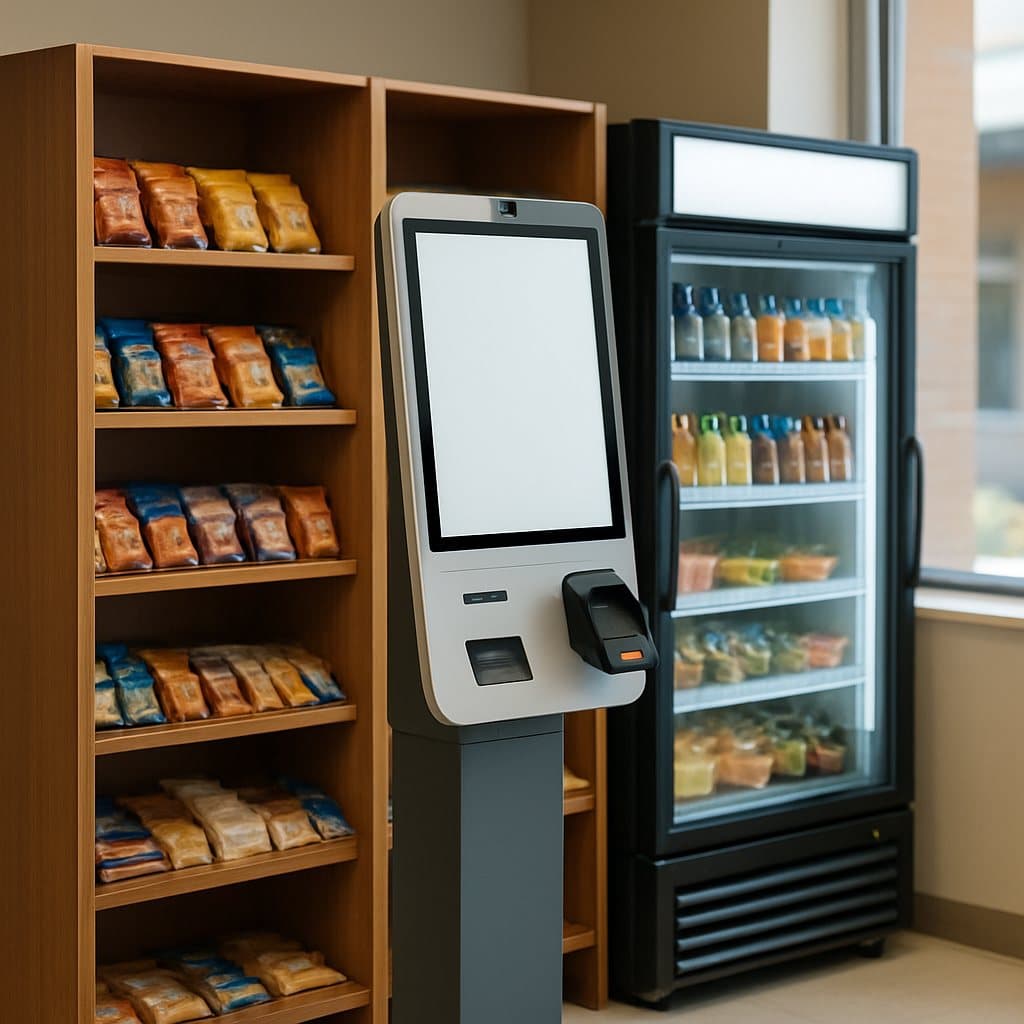
Think in zones rather than square feet. A workplace micro-market is usually built from three pieces: open shelving for packaged snacks and grab-and-go items, one or more refrigerated coolers for fresh food and cold drinks, and a slim self-checkout kiosk where people scan and pay. A modest setup can tuck along a single wall; a larger one spreads those zones into an open shop that a whole shift can flow through.
Map the room
We look at the breakroom you already have — its shape, the wall space, where the doors and tables sit, and how people enter and exit.Match the zones to the room
Shelving, coolers, and the kiosk get arranged to fit the space and keep checkout quick, scaled up or down to your headcount and variety needs.Confirm power and flow
We verify the coolers have appropriate power and that foot traffic moves smoothly, with nothing blocking the path to a table or the door.Right-size before installing
If the room is genuinely tight, we say so and recommend a compact build or vending instead — the market should fit comfortably, not crowd.
The point of thinking in zones is that it scales. The same three pieces serve a fifteen-person office and a two-hundred-person facility; only the size and count change.
Does a micro-market need special power or plumbing?
Beyond raw floor area, three practical things shape a good micro-market: power, layout, and the way people move.
Power is usually the simplest. Refrigerated displays need appropriate electrical, but most breakrooms already have what a standard cooler requires; we confirm the specifics during the walkthrough rather than guessing. Layout matters because a market that blocks the coffee station or the path to a table creates friction every single day. And traffic flow is the quiet make-or-break: on a thirty-minute lunch, a whole team should be able to grab food and check out without a bottleneck at the kiosk.
Waco's building stock makes this real, not theoretical. An older downtown office near the Magnolia district has a very different breakroom than a newer Woodway or Hewitt commercial suite, and a layout that sings in one would stumble in the other. We design to the room you actually have.
What if your Waco breakroom is too small for a micro-market?
Sometimes the room is simply small. That is not a dead end — it is just a different starting point.
When square footage is limited, a compact micro-market built around a tight shelving run and a single cooler can still give a team real variety. And when the space genuinely cannot hold a market comfortably, we will say so plainly and point you toward vending machines for your Waco workplace instead, which fit nearly any footprint and still keep the breakroom stocked. Either way, you get an honest recommendation rather than a unit forced into a room it does not fit.
How we evaluate your breakroom
None of this should fall on you to figure out alone. Before we recommend anything, we walk your breakroom, take stock of the space and the power, and watch how your team uses the room.
From there, we design a layout that keeps checkout quick and the space open and inviting — or we tell you honestly that a micro-market for a Waco workplace is not the right fit yet and a couple of machines would serve you better for now. If you are still weighing the two ideas at a conceptual level, our Waco employer's guide to micro-markets walks through what they are, and our look at the headcount where a micro-market starts to pay off covers the team-size side of the decision.
Because the goal was never to wedge equipment into a corner. It is to build a breakroom your people are genuinely glad to walk into — sized to fit the room, and sized to fit them.
People First. People Always.