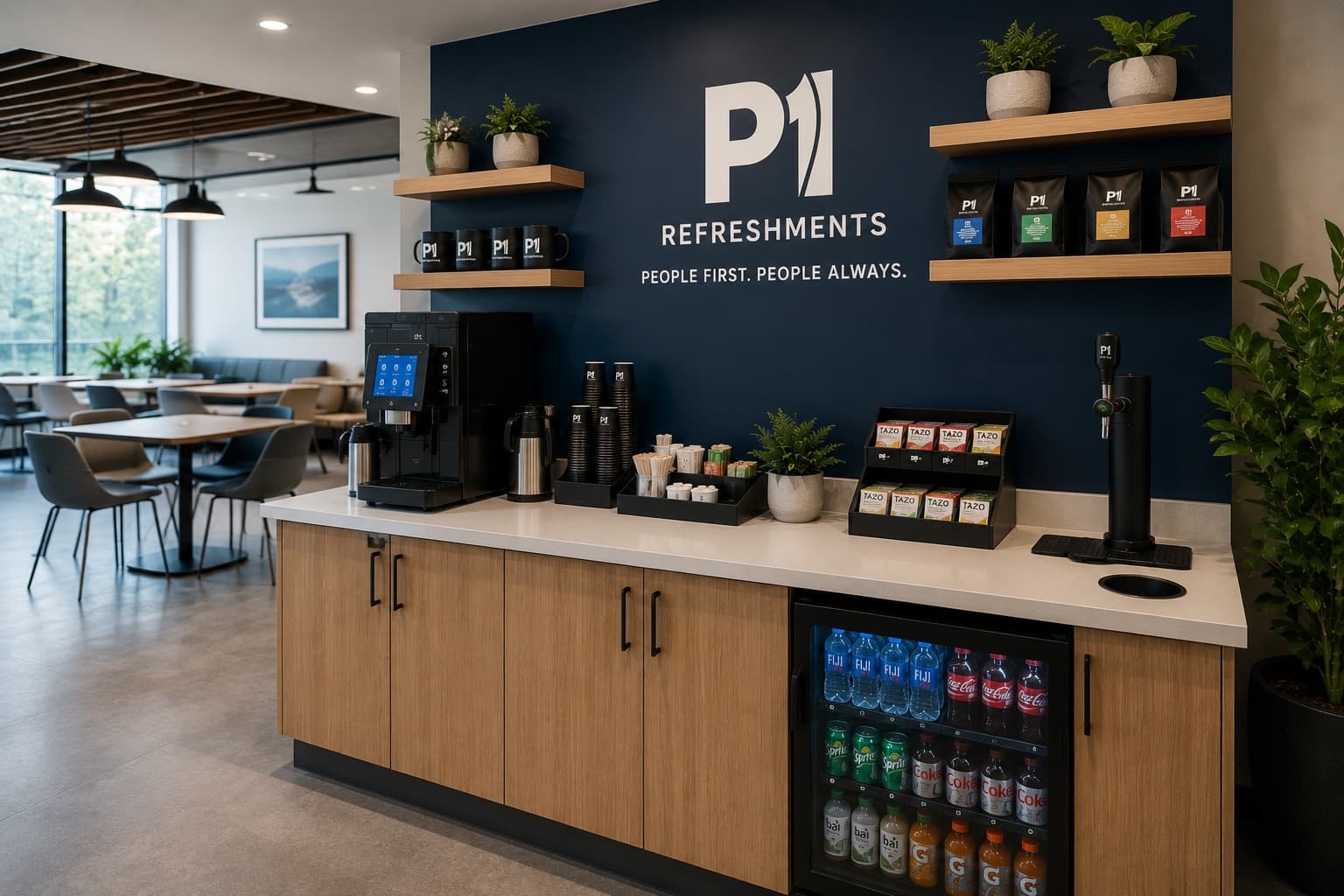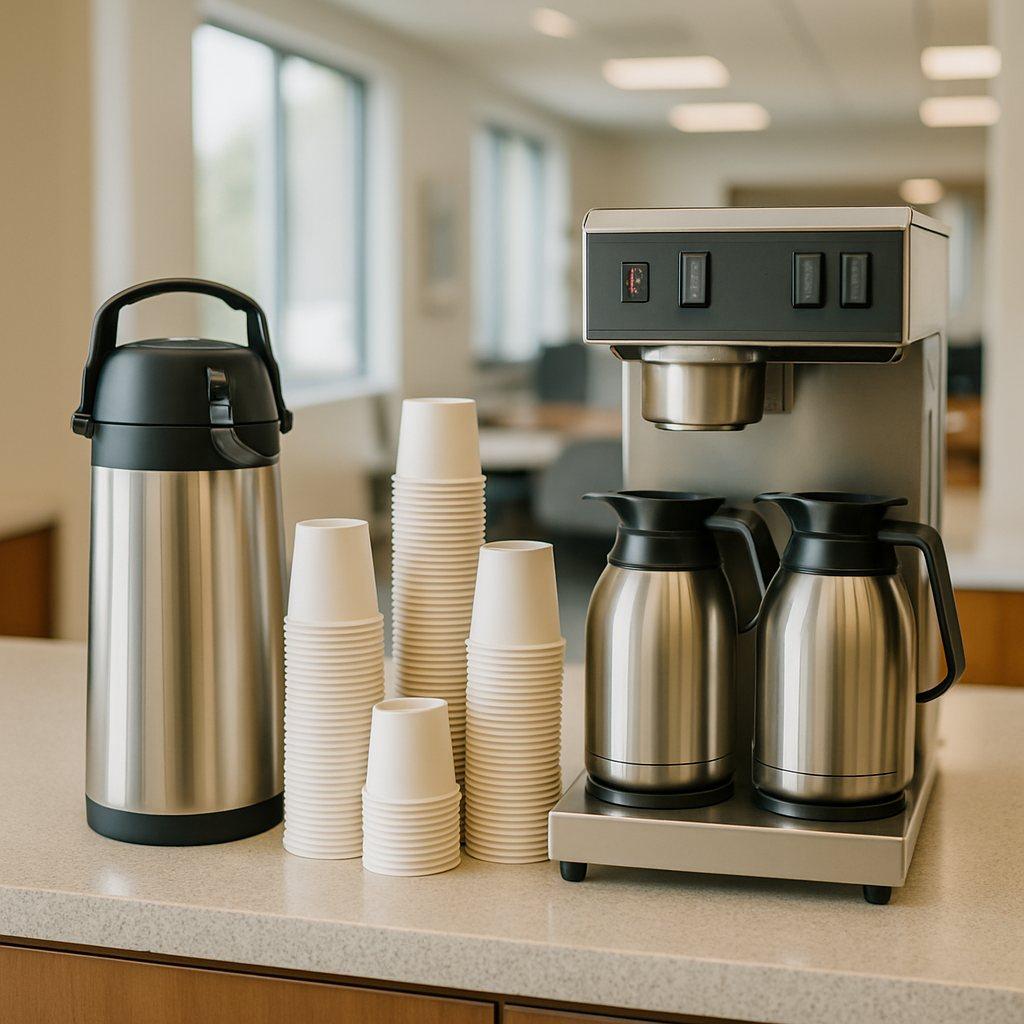
The best office coffee machine is the one that matches your headcount, how much your team drinks, and whether the cup is client-facing — not the priciest or trendiest. Pod machines suit small teams wanting variety; bean-to-cup fits steady daily demand; airpot and thermal brewers handle high volume and shifts; a traditional brewer is the simple, dependable option.
"Which coffee machine should we get?" sounds like a one-answer question. It is not. The right brewer for a quiet eight-person office is the wrong one for a fifty-person floor that runs through coffee from open to close, and both differ from what a client-facing firm wants in its lobby. So rather than crown a single winner, here is the honest decision tree: the four machine types, what each is genuinely good at, and how to land on the one that fits your team.
How do I choose an office coffee machine?
Start with three questions, in this order, because they narrow the field fast.
- How many cups, at peak? Not headcount alone, but how many cups get poured at the busiest stretch of the morning. That single number rules machine classes in or out faster than anything else.
- How does your team like its coffee? Same cup every time, or variety per person? Fresh-ground quality, or convenience and zero cleanup? The answer points you toward pots versus per-cup brewing.
- Who sees the cup? A staff-only breakroom and a client-facing lobby are different jobs. The lobby cup is part of the impression you make, which raises the bar.
Answer those three and you have usually narrowed four options to one or two. The rest is matching the details.
The four office coffee machine types, compared
Each machine class is built for a different job. Here is the head-to-head on what actually drives the choice.
| Machine type | Best fit | Strength | Trade-off |
|---|---|---|---|
| Single-serve / pod | Small teams, variety, lower volume | Per-cup variety, zero cleanup, no waste of a half-pot | Higher per-cup cost, more packaging |
| Bean-to-cup (super-automatic) | Steady daily demand wanting fresh-ground quality | Grinds fresh every cup; espresso menu possible | Needs routine maintenance and cleaning |
| Airpot / thermal brewer | High-volume floors and multi-shift sites | Brews and holds a lot, ready through peaks | Less per-cup variety; brew-batch model |
| Traditional / pour-over | Simple, dependable, budget-minded | Fewest moving parts, easy to run | No fresh-grind; basic experience |
Read across that table and the pattern is clear: variety and convenience push you toward pods, fresh-ground quality at steady volume toward bean-to-cup, sheer throughput toward airpot and thermal brewers, and simplicity toward a traditional unit. None is "better." Each is better at something.
Choosing by team size and how they drink
Volume is the lever that matters most, so let it lead.
A smaller team — roughly eight to fifteen people — is often well served by a pod machine or a compact bean-to-cup unit. Demand is steady but not heavy, variety is easy to offer, and you avoid brewing pots that go stale. A busy floor of fifty-plus, or any multi-shift site, usually needs an airpot or thermal-brewer setup that can keep coffee ready through the morning rush without anyone babysitting a slow drip. The volume, not the headcount on paper, is what decides it.
How your team drinks is the tiebreaker. A crew that wants a different drink per person leans pod. A floor that drinks the same dependable cup all day, and notices when it is fresh, leans bean-to-cup or thermal. If you have already narrowed it to those two, our side-by-side on bean-to-cup versus single-serve coffee in Waco walks the exact trade-off in detail.
Is a bean-to-cup or pod machine better for an office?
They win at different things, so the honest answer is "it depends on volume and what your team values." A bean-to-cup machine grinds fresh for every cup, which most coffee drinkers notice, and tends to cost less per cup once volume is steady — the trade is routine maintenance. A pod machine offers per-cup variety and zero cleanup, with a higher per-cup cost and more packaging. For a team that drinks coffee all day, bean-to-cup usually pencils out; for variety and convenience at lower volume, a pod machine fits better.
What about the cup your clients see?
If coffee is part of how you greet visitors, the machine carries more weight than it does in a staff-only breakroom.
A client-facing lobby or a professional firm where the coffee is part of the first impression usually justifies a bean-to-cup machine with an espresso menu, so a guest can have a real latte or cappuccino without anyone running to a café. It signals care, and it costs less than the repeated coffee-shop runs it replaces. For a staff breakroom where dependable, good coffee is the goal, a thermal brewer or a solid bean-to-cup unit does the job without the premium. The point is to match the machine to the moment, not to over-buy by default.
Where the managed model changes the decision
Here is the part that reframes the whole choice: in a managed office coffee program, the machine is not a purchase you weigh against your budget.
We provide and maintain the equipment as part of the service, so there is no upfront brewer purchase sitting on your books and no repair bill landing on your desk. You fund the coffee and supplies your team actually drinks; the machine, the upkeep, and the restocking are ours. That turns "which machine can we afford?" into the simpler, better question: "which machine fits our team?" For the full picture of what that service covers, what's included in a managed office coffee program lays out every piece.
That is the standard behind our managed office coffee service and office coffee for Waco workplaces: we help you pick the right brewer for your people, then we own the rest. And the freshness question — whether the machine needs a water line — is its own decision, which our look at whether an office coffee machine needs plumbing answers in plain terms.
Because the best coffee machine is never the one with the longest spec sheet. It is the one your team reaches for every morning without a second thought.
People First. People Always.