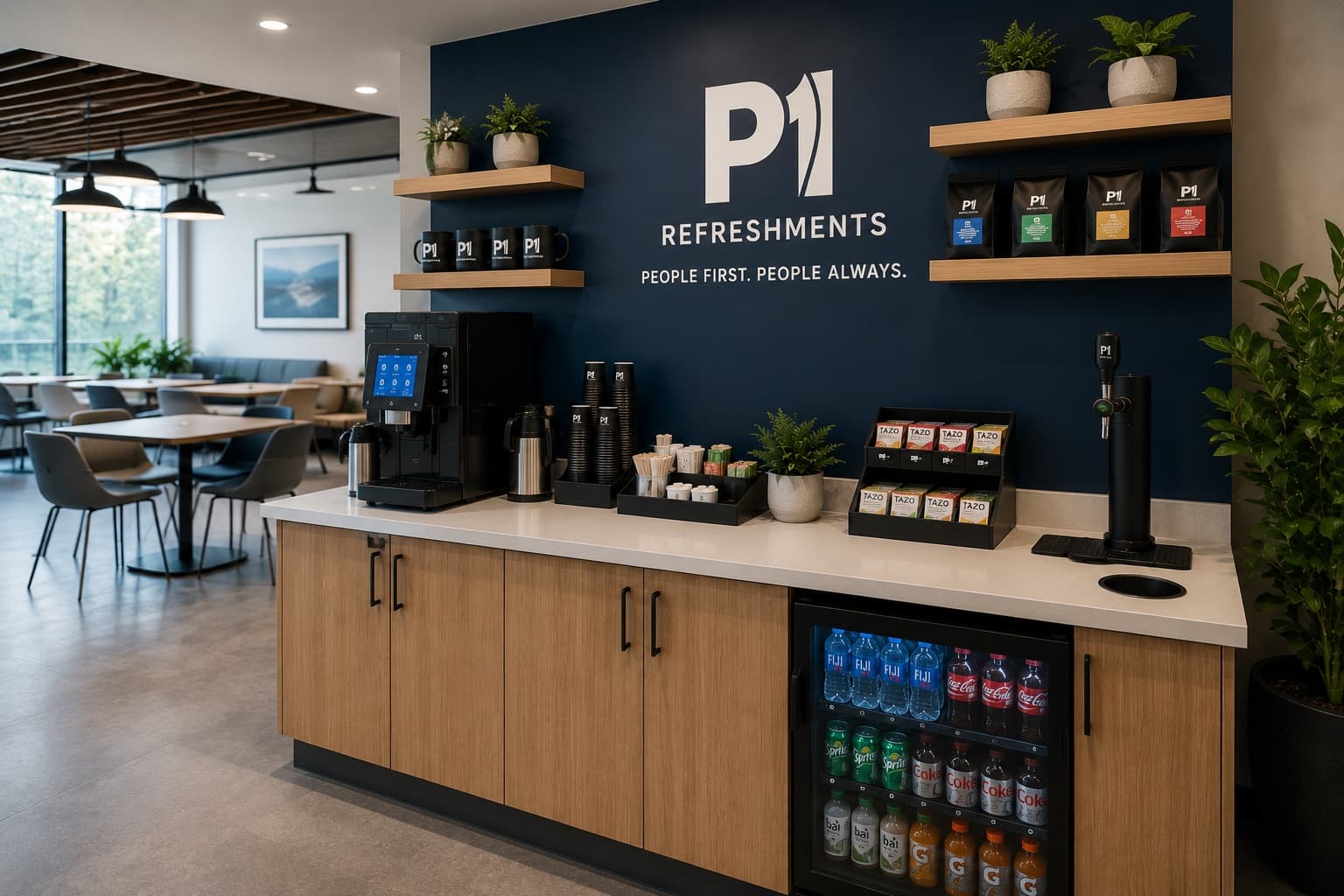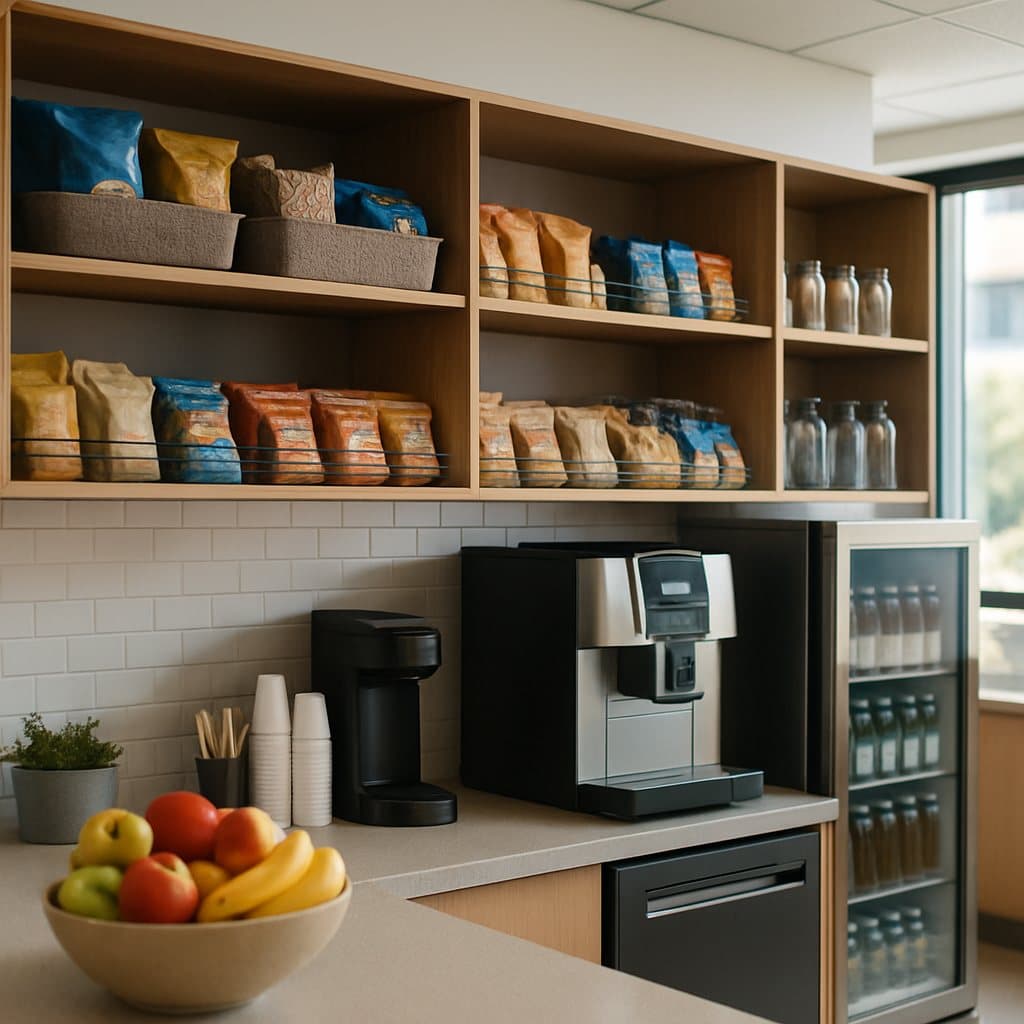
An office pantry program costs an employer no fixed price — you pay for the product, and the spend scales with your headcount, your product mix, and how often we restock. With a company-sponsored pantry, your organization covers the complimentary snacks, drinks, and breakroom essentials, and we handle everything else. As a reference frame, published industry benchmarks group pantry spend into roughly $5, $7–8, and $10+ per employee, per day — though we build to fit your team and Waco product costs rather than a package.
There is a moment, usually right after an employer decides a pantry is a good idea, when the next question arrives: "Okay — what does this actually cost?"
It is a fair question, and we answer it the same way every time. There is no off-the-shelf price, because a pantry that fits a ten-person Waco office is not the same program a hundred-person one needs. What we can do is be clear about how the model works and what drives the number, so you can decide with your eyes open.
This post walks through exactly that — no invented P1 figure, just the mechanics and an honest industry frame.
What does a "company-sponsored" pantry mean?
A pantry program is different from vending, and the difference is who pays at the point of use.
With a pantry, the snacks, beverages, and breakroom essentials are complimentary to your team. Your organization sponsors them — that is the part you fund. Employees do not pull out a card or a phone; they simply take what they need. The breakroom becomes a benefit, not a transaction.
That single design choice is what makes a pantry feel generous in a way a machine cannot. It is also why the cost works differently, which is the part worth understanding before you commit to anything.
You pay for product. We handle the rest.
Here is the whole arrangement, start to finish.
Tell us about your team
We learn your headcount, the snacks and drinks your people actually reach for, and how your workplace runs — before we quote a thing.You sponsor the product
Your organization covers the complimentary snacks, beverages, and breakroom essentials. That spend scales with headcount, product mix, and restock frequency.We handle everything else
We plan, order, deliver, stock, monitor inventory, and rotate product. The breakroom never becomes another job for your staff.Start small and scale as it proves out
Begin with a focused selection and grow the program as it earns its place. The pantry evolves right along with your business.
Notice the split: you fund the product, and the labor of running the program is ours. You are not paying us to babysit a closet of snacks — you are sponsoring a benefit, and we make it disappear into the background.
How much does an office pantry program cost?
If there is no set price, what moves the number? Three things, mostly.
- Headcount. More people means more product moving through the breakroom. The cost tracks how many mouths you are feeding, which is exactly why a fixed package rarely fits.
- Product mix. A pantry built around coffee, water, and a few healthy staples sits at one level. One stocked with fresh options, premium snacks, and a wide variety sits at another. You choose the tier.
- Frequency. How often we restock — and how full you want the shelves to stay — shapes the ongoing spend. A heavily used breakroom in a busy Waco office naturally runs through more than a quieter one.
None of those are surprises we spring on you. We walk through all three up front so the program fits the budget you actually have.
Because the model is build-to-fit, the honest way to sketch a number is by tier. Industry pantry-program benchmarks generally group spend into three per-employee, per-day levels — a useful reference point for what an employer-sponsored breakroom tends to run, before we right-size yours to Waco product costs and your actual usage:
| Tier | Typical spend (industry benchmark) | What it looks like |
|---|---|---|
| Essentials | About $5 per employee, per day | Coffee, tea, water, and a focused set of go-to snacks |
| Elevated | Roughly $7–$8 per employee, per day | More variety, name-brand snacks, fresh options |
| Premium | $10+ per employee, per day | Broad fresh-food selection, premium and wellness-forward items |
Those figures are published industry ranges, not our price — we do not work off a fixed package. They simply show why headcount and product mix drive the number, and give you a realistic frame before we build a program around your team and budget.
Grounding it in the Waco you operate in
It helps to set the cost against the market you are hiring in. The typical Waco household earns about $51,468 a year, with the wider McLennan County figure closer to $63,888. Those are the everyday budgets your team lives on — and the reason small, tangible perks land so hard here. A stocked breakroom is something people feel every single day, in a paycheck-stretching way that an annual line item on a benefits sheet never quite does.
That is the lens we bring: a pantry should make sense for your business and feel meaningful to your people. When both are true, the spend is doing real work.
Can you start a small pantry and scale up later?
The smartest way to begin is rarely the most elaborate one. Plenty of employers start with a focused selection — coffee, a handful of go-to snacks, cold drinks — and expand once they see the breakroom fill up and the thank-yous start. The program grows with the business, not ahead of it.
If you want the emotional case for why a stocked breakroom matters in the first place, our piece on what a stocked breakroom tells Waco employees covers that ground. And if you are weighing a pantry specifically as a way to keep good people, pantry programs as a Waco retention tool makes that case directly.
Either way, the mechanics are the same across our managed pantry program and everything in our pantry programs for Waco workplaces: you sponsor the product, we handle the rest, and the breakroom stays stocked without anyone on your staff thinking about it.
Because the return on a pantry rarely shows up on a receipt. It shows up in the person who felt looked after on a hard afternoon — and that is the whole point.
People First. People Always.