For a growing Hewitt plant, switch from vending to a micro-market once headcount, foot traffic, and the hours you run outgrow a couple of machines and crews want a real meal, not just a snack. Until then, vending is still the right floor.
Most manufacturers do not set out to upgrade their breakroom. It happens the other way around: headcount climbs, a second shift gets added, and one morning the two vending machines that used to be plenty are picked over by 10 a.m. The breakroom quietly stopped keeping up, and nobody planned for it.
Manufacturing is a real part of Hewitt's working life. It employs roughly eleven percent of residents who work here, second only to education and healthcare, and the plants along Enterprise Boulevard and the Sun Valley corridor — stadium-seating fabrication, utility-equipment builders, spray and agricultural-equipment shops — are the kind of operations that grow in steps. When a plant adds a line or a shift, the breakroom is usually the last thing anyone thinks about, and the first thing the crews notice.
So this is the honest comparison a growing Hewitt manufacturer actually needs: vending versus a micro-market, when each one fits, and how to tell you have outgrown the machines.
When should a manufacturing plant switch from vending to a micro-market?
A plant should move from vending to a micro-market once the machines empty before the late shift, crews want a real meal instead of a snack, and the line backs up at shift change — the signs you have outgrown a fixed amount of room behind glass. A vending machine is a dependable floor, but a busy plant can simply outrun it.
The signs are familiar. The popular items sell out before the late shift arrives. People want a real meal, not just a snack, on a long day. The line at two machines backs up during a shift change. None of that means vending failed — it means the plant grew past what a couple of machines can hold, which is a good problem to have. The question is what comes next.
What is the difference between a micro-market and vending for a plant?
For a manufacturing floor, the difference is variety and fresh food: vending is shelf-stable snacks and drinks behind glass, while a micro-market is an open self-service store with refrigerated meals, far more choice, and a self-checkout that feeds a whole shift at once. The clearest way to see it is to put them side by side.
| Vending | Micro-Market | |
|---|---|---|
| Variety | Limited to what fits behind glass | Far wider — full open shelving and coolers |
| Fresh food | Minimal | Yes — meals, salads, fruit, dairy |
| Footprint | One or two machines against a wall | A small open store area in the breakroom |
| Checkout | Pay at the machine, per item | Self-checkout kiosk, scan and go |
| Shift split | One machine suits ~40-50 on-site at a time | Earns its space past ~75 across the day, even split over 2nd and 3rd shift |
| Feel | Functional and familiar | Open, store-like, you see what you pick up |
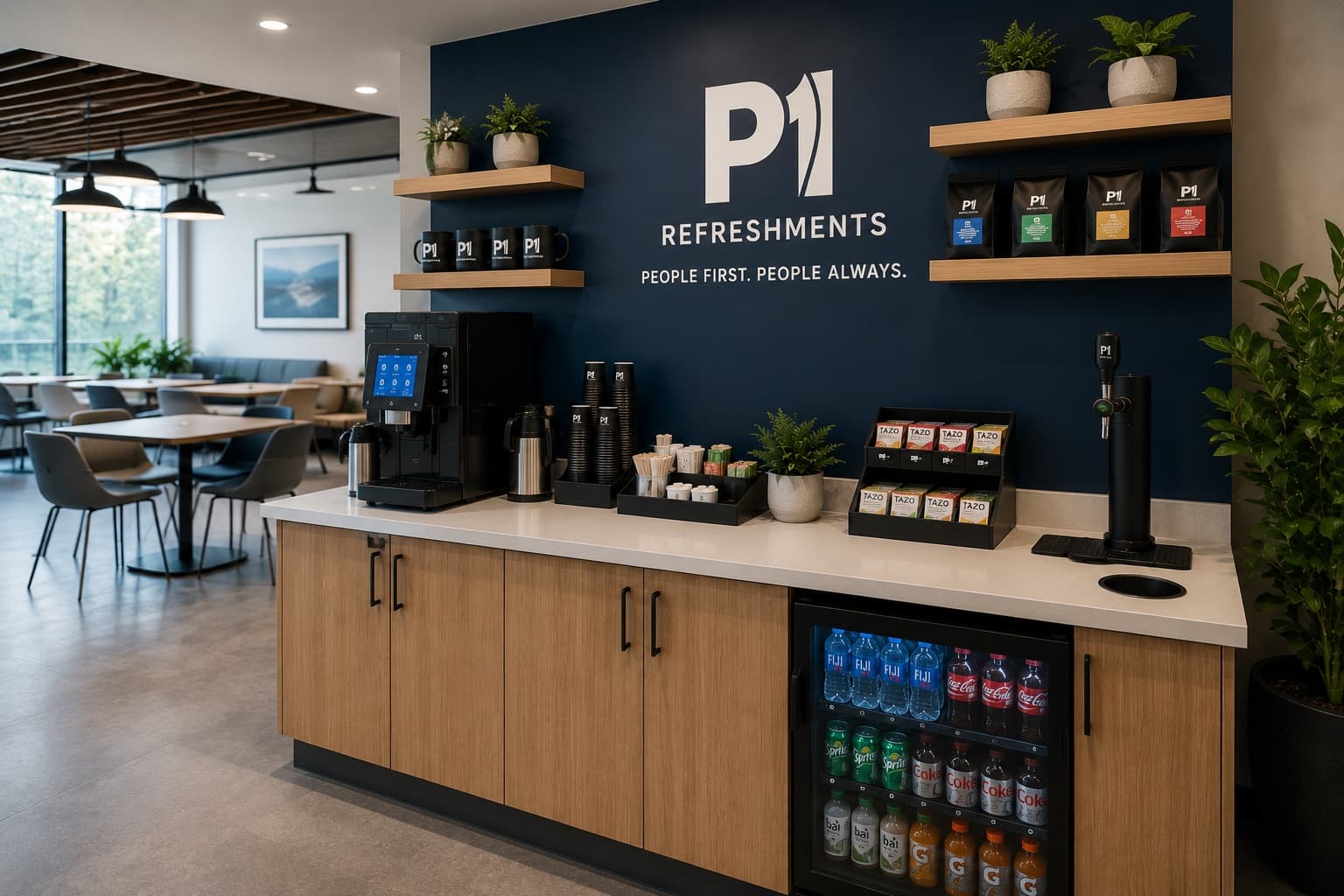
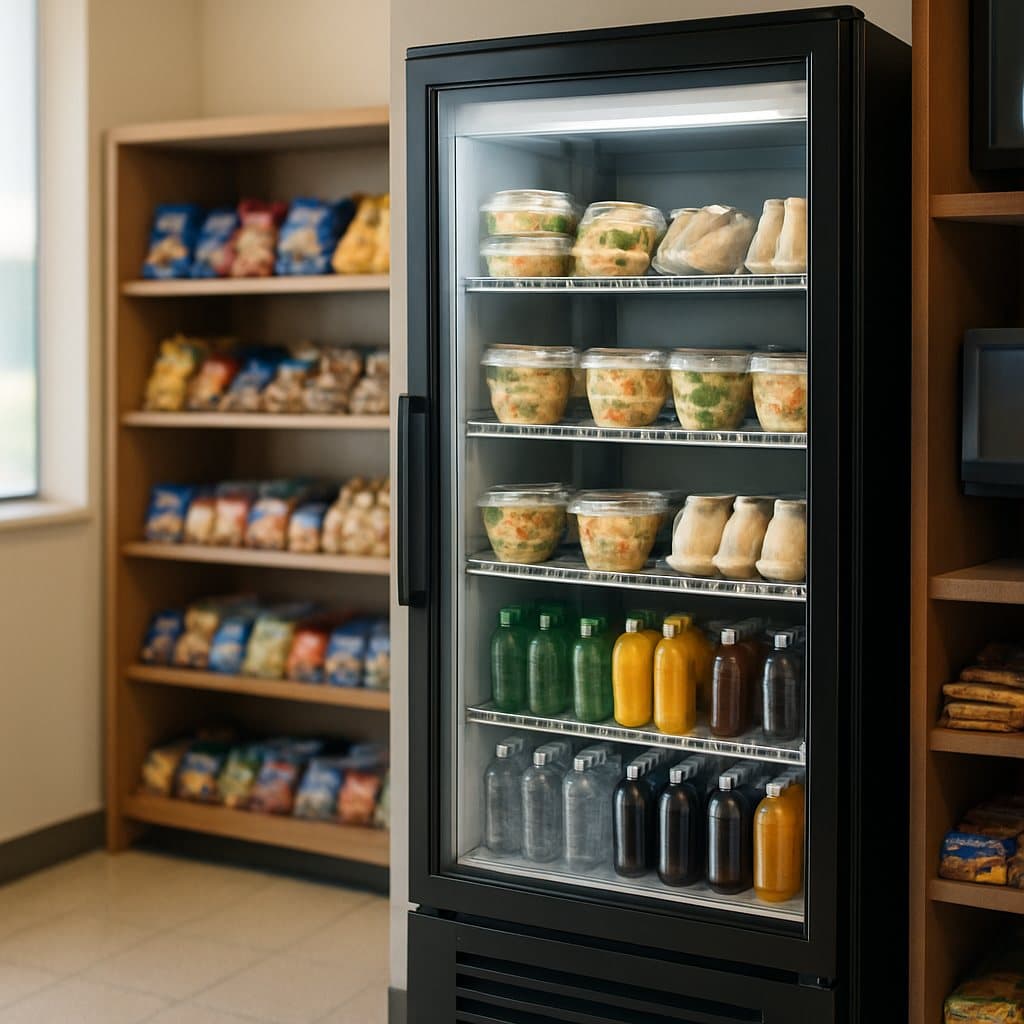
The clearest practical gap is fresh food and variety. A machine is built around shelf-stable snacks and drinks; a micro-market opens up refrigerated meals, fresh options, and a much larger selection, all out in the open where people can see and choose. For a crew working a long shift, that difference between a snack and an actual meal is the whole point.
How many employees does a manufacturing plant need for a micro-market?
There is no single magic number, but a useful guide: one vending machine tends to fit a floor of roughly 40 to 50 on-site people, and a micro-market starts to make sense once you are past about 75. On a plant that runs a second or third shift, read that across the whole day, not one shift at a time. Forty workers on first, twenty-five on second, and fifteen overnight is seventy-five people passing through the same breakroom — enough to keep a market's fresh food moving even though no single shift would justify it alone. That all-day, split-shift headcount is exactly the case where a market quietly pays off and a couple of machines do not.
Why a 24-hour plant leans toward a market
A plant that runs around the clock has a particular problem: the late shifts are the hardest to feed, and they are the ones a stretched vending setup serves worst.
A micro-market answers that well because it never closes and never needs a cashier. Any shift — first, second, or third — can walk up at any hour and get a fresh meal, a drink, or a snack without leaving the building. For an operation where the overnight crew is too often an afterthought, a market treats every shift the same way, which is exactly how it should be. This is the same around-the-clock thinking behind our vending service for Hewitt workplaces — a market simply scales it up for a bigger floor.
Can a micro-market handle a 24-hour manufacturing shift?
Yes. A micro-market stays open with no cashier, so first, second, or third shift can grab a fresh meal or snack at any hour without leaving the building. That suits a plant running production around the clock, where the overnight crew is the hardest to feed and the worst-served by a stretched set of machines. The market does not care what time it is — which is the whole reason a 24-hour floor leans toward one.
Does my Hewitt plant have enough space and hours for a micro-market?
Headcount is the start of the answer, not the whole of it — space and hours matter just as much, and they are the part most plants forget to weigh.
Space comes first: a market needs a small open area in the breakroom, more than a machine against a wall but far less than people expect, so a tight breakroom can rule one out even when the headcount is there. Hours come next, because the more of the clock your plant runs, the more a no-cashier market pays off against vending that nobody is restocking overnight. And foot traffic ties it together — a market earns its footprint when enough people pass through often enough to keep fresh food from sitting. We look at all three on your actual floor, alongside the headcount, before we say a word about equipment.
Who restocks and maintains a micro-market on a plant floor?
We do. Inventory monitoring, scheduled restocking, and equipment upkeep are ours to handle, so the breakroom never becomes another job for your team or your floor supervisors. On a working floor that already runs lean, that matters: nobody on your crew has to notice the coffee is low or chase down a vendor when a cooler needs service. The market simply stays stocked and running, the same way our vending does.
The honest answer for a growing Hewitt manufacturer
Here is what we tell every plant that asks. If you have clearly outgrown vending — the machines empty out, people want meals, the headcount is there — a managed micro-market is usually the right next step. If you are close but not quite, there is no shame in staying with vending a while longer, or running both.
We would rather tell you to wait than sell you a market your floor is not ready for. If it turns out a managed pantry program for a Hewitt workplace fits your goals better, we will say that too. The conversation starts with listening, and we strive to respond within 24 hours when you reach out — to a real person who knows your account, not a distant call center.
Because the breakroom is one of the few places your crews visit every single shift. Getting it right as your plant grows is one more way to tell the people on the floor that someone is paying attention.
People First. People Always.